.webp)
.webp)
.webp)
.webp)
.webp)
Ferrari has confirmed that its first fully electric car will be called Luce. Light, if you are wondering. While the exterior will be revealed later this year, Ferrari has chosen to show us the interior first. That decision alone tells you where the real story is.
Because the Luce’s cabin has been designed by Jony Ive, the man who helped define how the modern world interacts with technology during his years at Apple. He now runs his own design collective called LoveFrom and this is its most ambitious automotive project yet.
The brief given to the team seems to be very simple. Build an interior that feels physical, intuitive and timeless in an era where cars are drowning in touchscreens. The execution, as you might expect, is anything but simple.
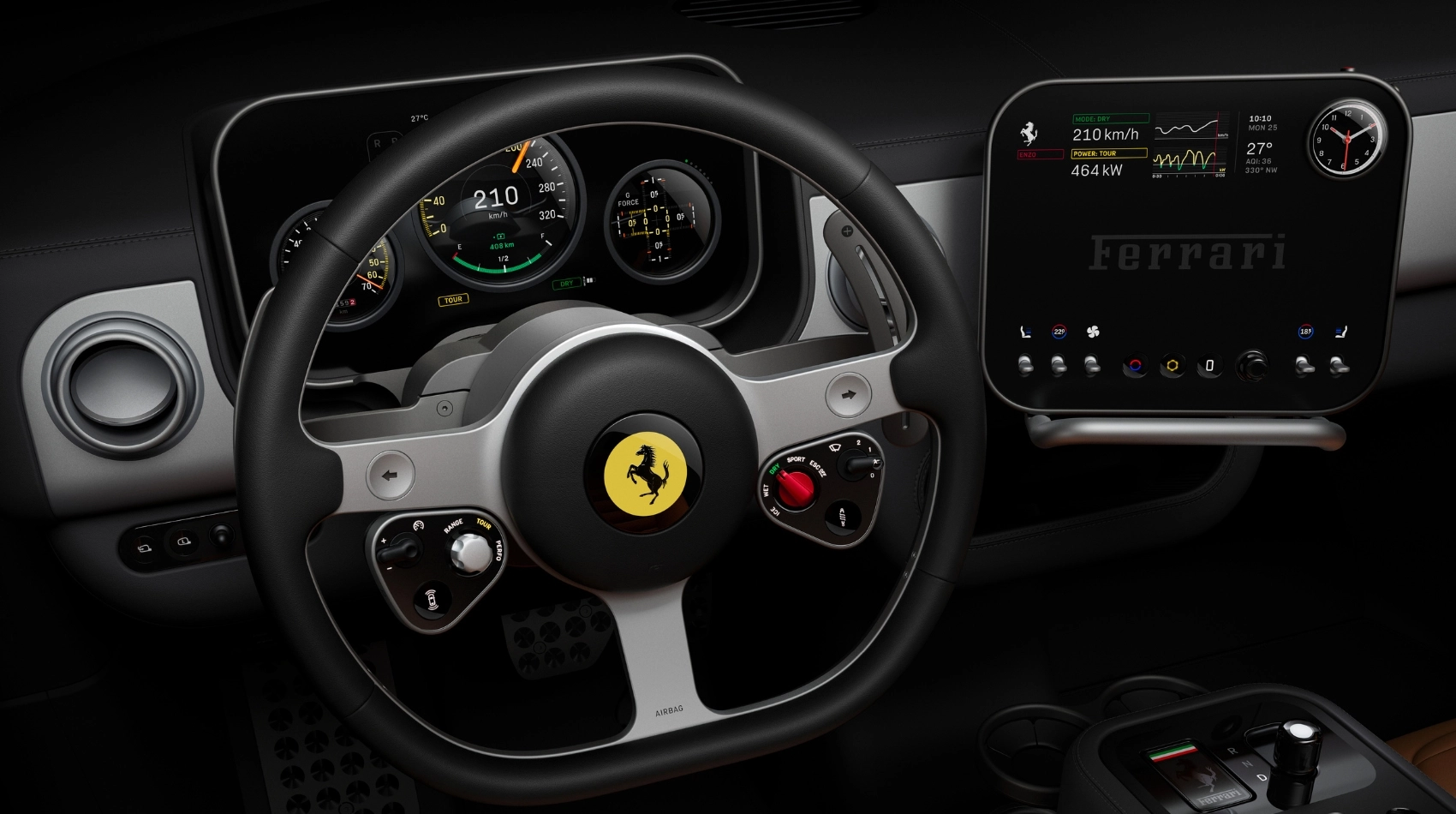
At first glance, the layout looks refreshingly restrained. A compact instrument cluster, a three-spoke steering wheel and a standalone central display sit against an aluminium structure with four beautifully machined air vents. Look closer and the obsession with detail becomes obvious. There is no visible plastic. Every surface you touch is metal, glass or leather, finished to tolerances that would not look out of place in a watchmaker’s studio.
The 12.86-inch digital instrument cluster is a sculptural object in its own right, with softly rounded edges and physical aluminium needles illuminated by LEDs. The graphics take inspiration from classic Ferrari dials, but the tech behind them is thoroughly up-to-date, using advanced OLED panels developed with Samsung to deliver deep contrast and clarity without visual clutter.
Ferrari has resisted the temptation to move everything onto screens. The steering wheel is packed with physical controls, all machined from aluminium and designed to be operated without taking your eyes off the road. On the right, a rotary dial lets you switch between Range, Tour and Performance modes for the electric powertrain, which is expected to produce well over 1,000 bhp. On the left, a reworked manettino handles chassis settings. Paddle shifters remain, with one controlling regenerative braking and the other managing torque delivery under acceleration.
The central touchscreen measures 10.12-inches and sits on a ball-and-socket mount, allowing it to pivot towards either the driver or passenger. There is even a palm rest, a small but telling detail that acknowledges how awkward touchscreens can be in moving cars. Climate controls are handled by proper physical switches, not menus buried three layers deep.
Materials are a big part of the story. Anodised aluminium is used extensively, machined from solid billets using CNC processes. Glass plays a starring role too, developed with Corning using techniques never before applied in a car. The centre console glass panel alone features over 13,000 laser-drilled micro holes for backlighting, finished in a way that resists fingerprints. Even the key gets special treatment, changing colour when docked into the console using e-ink technology.
Ferrari chairman John Elkann has confirmed that the name Luce was chosen deliberately. This is not meant to be seen as just an electric Ferrari. It is intended to be something broader, more enduring.
There is still much we do not know. Pricing has not been announced and the exterior remains under wraps until later this year. But one thing iwe know for sure. Ferrari has not treated its first EV as a compliance exercise. By starting with the interior and by handing it to one of the most influential designers of our time, Ferrari's statement and intent will influence the auto industry for the coming years. Ferrari's best interior yet in the current era?