
Hyundai Creta

NA
This is a big one. The no-nonsense, no-fluff, no-favouritism compact SUV mega test.
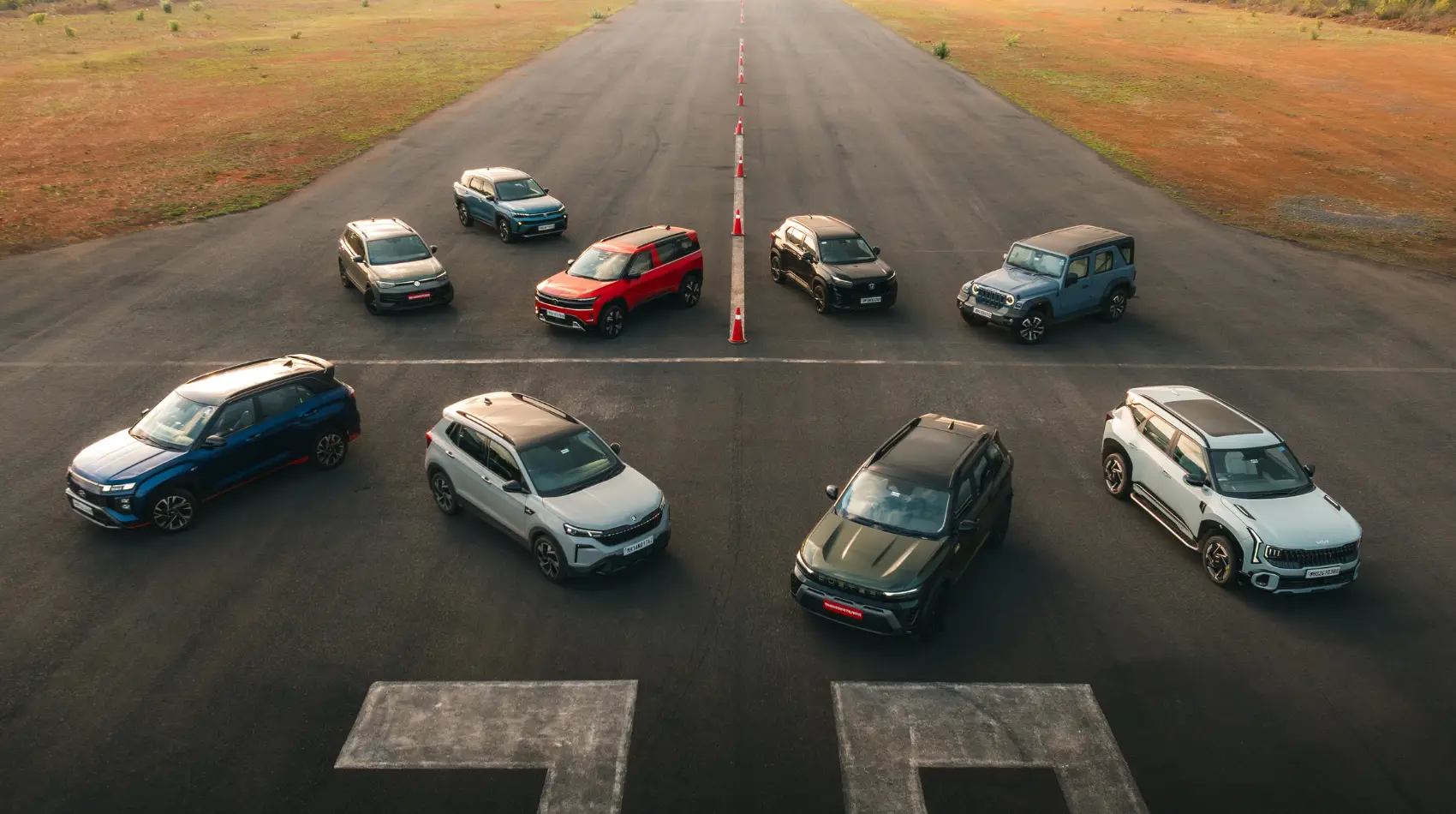
The cars in this test are the Renault Duster, the new Tata Sierra, Volkswagen Taigun, Skoda Kushaq, new Kia Seltos, Maruti Suzuki Victoris, Hyundai Creta, Mahindra Thar Roxx, Honda Elevate, MG Astor and Toyota Urban Cruiser Hyryder. Well, almost. MG decided not to show up despite us being in constant touch with them, which is a shame because the Astor could really have used a day out in the real world. Toyota, for reasons best known to Toyota, decided the Hyryder would not participate either. The Maruti Suzuki Grand Vitara also wasn’t present, but in its place we had the Victoris, which is essentially the same mechanical package. The Tata Curvv didn’t make it either, but with the Sierra now taking over as Tata’s big statement in this space, including both felt unnecessary.
Every single test you will see here has been documented on camera and backed by proper instrumented testing equipment. No vibes. No “it feels quick”. No “this one seems quieter”. Just measurable, repeatable data that should help you make a properly informed decision before buying what is, for most Indian families, their primary car. It is also, rather selfishly, one of the most enjoyable things we have ever done. Turns out, lining up a bunch of family SUVs and making them fight scientifically is tremendous fun.
For this test, we picked the most expensive petrol automatic version of every car. That keeps things fair, because these are the variants that best represent each product, the ones we usually recommend, and the ones most buyers actually ask us about.
There are seven tests in total. Three performance tests: 0-100kmph, quarter mile and slalom. Two comfort tests: rear seat space and cabin sound levels. Then come the two big real-world deciding factors: fuel economy and price, with all prices taken as ex-showroom Delhi.
By the end of this, there will be one winner. Not because we liked it more, but because the numbers said so.
The first test is the most basic, most brutal, and possibly the most universally understood performance metric of them all. The 0-100kmph run.
Now, before ‘sensible’ people begin sharpening their keyboards, no, a 0-100 time does not tell you everything about a car. But it does tell you one very important thing. When you put your foot down, how much fight does the car actually have?
And in this test, the Hyundai Creta came out swinging. With a time of 9.26 seconds, it was the only car here to dip under the 10-second mark, and that immediately puts it in a different league. This is not just quick for the segment, it is properly quick for what is still, at heart, a family SUV. Ten points, full marks, and a very smug look on its face.
Then came the surprise. The Mahindra Thar Roxx, a car shaped like it was designed using a ruler and a gym membership, clocked 10.27 seconds, that 2-litre engine really coming in handy! The Kia Seltos followed closely at 10.5 seconds, proving once again that it is still one of the sharpest, most energetic cars in this segment finished ahead of the Euro wins!
The Volkswagen Taigun and Skoda Kushaq came next, with 10.9 seconds and 11.29 seconds respectively with almost nothing between them. Respectable, punchy and very much in the mix, though not quite fast enough to trouble the podium. The Renault Duster managed 11.87 seconds, which is decent, while the Tata Sierra, at 12.42 seconds, felt more relaxed.
Then came the calmer end of the field. The Maruti Suzuki Victoris clocked 13.14 seconds, and the Honda Elevate took 13.64 seconds, making them clearly more comfort-cruiser than drag-strip hero.
As for the MG Astor and Toyota Urban Cruiser Hyryder, well, they didn’t show up. Which is unfortunate, because the stopwatch is usually far more polite than public opinion.
| 0-100kmph Test (Measured On Draggy App) | ||
| 0-100kmph Time | Points | |
| Hyundai CRETA | 9.26s | 10 |
| Mahindra THAR ROXX | 10.27s | 9 |
| Kia SELTOS | 10.5s | 8 |
| VolkswagenTAIGUN | 10.9s | 7 |
| Skoda KUSHAQ | 11.29s | 6 |
| Renault DUSTER | 11.87s | 5 |
| Tata SIERRA | 12.42s | 4 |
| Maruti Suzuki VICTORIS | 13.14s | 3 |
| Honda ELEVATE | 13.64s | 2 |
| MG ASTOR | NO SHOW | NO SHOW |
| Toyota URBAN CRUISER HYRYDER | NO SHOW | NO SHOW |
Here’s the quarter-mile section in the same tone, with a nice bit of drama and explanation around the trap speeds:
Next up, the quarter mile.
Now this is where things get a little more interesting. A 0-100kmph run tells you how hard a car launches and how quickly it gets to three digits, but the quarter mile tells you how well it keeps going. It is not just about the initial punch. It is about the engine, the gearbox, the power delivery, the traction, and whether the car still has something left to give once the first burst of acceleration is over.
And once again, the Hyundai Creta walked away with it. A 16.86-second quarter mile at 132.20kmph is properly impressive for a compact SUV, and more importantly, it also had the highest terminal speed of the lot. That means it wasn’t just quick off the line. It was pulling hard all the way through.
The Mahindra Thar Roxx finished second with a 17.16-second run, which is frankly hilarious in the best possible way. This is a tall, square-shouldered SUV that looks like it should be thundering up a mountain trail, not bothering family crossovers on a drag strip. But with that big 2-litre engine, it proved that brute force and a good launch can still embarrass some very polished machinery.
The Volkswagen Taigun was the big mover here. While it finished behind the Seltos in the 0-100 run, it clawed back a position in the quarter mile with a 17.39-second pass at 130.92kmph. That strong terminal speed tells you the VW was still pulling cleanly at the far end. The Kia Seltos followed at 17.55 seconds, with the Skoda Kushaq just behind at 17.71 seconds. Interesting to note that in the pre-facelift version, the Skoda Kushaq was consistently faster than the Taigun, now though, not the case anymore.
The Renault Duster came in at 17.93 seconds, which is disappointing for how much horsepower it makes, while the Tata Sierra, at 18.30 seconds, was more steady than savage. The Maruti Suzuki Victoris clocked 18.75 seconds, and the Honda Elevate brought up the rear at 19.29 seconds - both let down by their CVT gearboxes despite having great initial bite from the hybrid and NA engines respectively.
| Quarter Mile Test (Measured On Draggy App) | ||
| Quarter Mile Time | Points | |
| Hyundai CRETA | 16.86s @ 132.20kmph | 10 |
| Mahindra THAR ROXX | 17.16s @ 125.69kmph | 9 |
| VolkswagenTAIGUN | 17.39s @ 130.92kmph | 8 |
| Kia SELTOS | 17.55s @ 129.08kmph | 7 |
| Skoda KUSHAQ | 17.71s @ 129.30kmph | 6 |
| Renault DUSTER | 17.93s @ 126.55kmph | 5 |
| Tata SIERRA | 18.30s @ 121.55 kmph | 4 |
| Maruti Suzuki VICTORIS | 18.75s @ 115.88kmph | 3 |
| Honda ELEVATE | 19.29s @ 119.55kmph | 2 |
| MG ASTOR | NO SHOW | NO SHOW |
| Toyota URBAN CRUISER HYRYDER | NO SHOW | NO SHOW |
Now, if the acceleration tests are about brute force, this is where the cars are asked a far more difficult question. Can you change direction? Can you carry speed? Can you keep your body under control? Can your steering, suspension, tyres, chassis and electronics all work together without turning the whole thing into a flustered mess?
The Maruti Suzuki Victoris absolutely came alive. With a time of 25.52 seconds, it was comfortably the quickest car through the cones, and honestly, this result was not entirely surprising. We have maintained for a while that this platform, is quite possibly the benchmark chassis in this segment. It has that rare combination of ride comfort and handling balance, and in the slalom, it showed exactly why. The hybrid system helped massively too. The instant response off the line and the clean, consistent power delivery through the direction changes meant the Victoris never felt like it was waiting for the engine or gearbox to wake up. It just went. Cleanly, calmly, quickly. Proper Japanese chassis tuning on display.
Second place went to the Renault Duster with a 25.96-second run, and again, no great shock there. The Duster has always had a fundamentally brilliant chassis, and this new one clearly carries that same sense of balance, grip and confidence.
The Kia Seltos was the big surprise. At 27.17 seconds, it finished third, and considering it is one of the larger cars in this test, that is seriously commendable. Even more impressive is the fact that it edged out the Volkswagen Taigun by just three hundredths of a second. The Taigun, at 27.20 seconds, was still very tidy, but the Seltos sneaking ahead of the Germans was not something we had on our bingo card.
The Honda Elevate and Skoda Kushaq followed closely, with the Hyundai Creta just behind them. The Thar Roxx, understandably, felt its size and height here.
The real disappointment, though, was the Tata Sierra. Tata usually knows how to tune a chassis, but at 30.32 seconds, the Sierra was nowhere near the sharp end. It may be comfortable, but in this test, it simply did not have the handling composure to match the best.
| Slaom Test (Measured On Stop Watch) | ||
| Slalom Time | Points | |
| Maruti Suzuki VICTORIS | 25.52s | 10 |
| Renault DUSTER | 25.96s | 9 |
| Kia SELTOS | 27.17s | 8 |
| VolkswagenTAIGUN | 27.20s | 7 |
| Honda ELEVATE | 27.64s | 6 |
| Skoda KUSHAQ | 27.75s | 5 |
| Hyundai CRETA | 28.00s | 4 |
| Mahindra THAR ROXX | 28.63s | 3 |
| Tata SIERRA | 30.32s | 2 |
| MG ASTOR | NO SHOW | NO SHOW |
| Toyota URBAN CRUISER HYRYDER | NO SHOW | NO SHOW |
On paper, the Mahindra Thar Roxx should not have won this. In fact, if you were making predictions before the test, you would probably have put it somewhere near the bottom. It has big all-terrain tyres. It has a tall, upright stance. It has a windscreen that is about as aerodynamically relaxed as a brick wall. And in general, it has the size, shape and visual attitude of something that should be loud, gruff and slightly uncivilised at speed.
Except, it wasn’t. The Thar Roxx recorded just 62.50db, making it the quietest car in this test, and not by a tiny, technicality-sized margin either. It was genuinely quieter than everything else here, and that is a massive win for Mahindra. For a car with this much road presence and this much off-road intent, to also deliver this level of cabin isolation is seriously impressive.
The Hyundai Creta continued its annoyingly consistent run of strong results with a reading of 64.95db. That is just a smidge under 65 decibels, and again, it shows why the Creta is such a difficult car to beat in this segment. It may not always be the most emotional choice, but it keeps scoring where it matters.
The Skoda Kushaq followed at 65.40db, with the Tata Sierra close behind at 66.30db, both delivering strong refinement figures. After that, the field became much tighter. The Volkswagen Taigun and Kia Seltos both recorded an identical 68.95db, while the Honda Elevate came in at 69.85db. The Maruti Suzuki Victoris registered 70.20db, and the Renault Duster was the loudest of the lot at 70.55db.
For this test, we used the highest-rated decibel measuring app on the iOS App Store. The process was simple and consistent: we recorded the highest and lowest sound readings inside the cabin during the test, and averaged the two to arrive at the final score. And somehow, the car that looked like it would shout the loudest ended up whispering the best.
| Cabin Noise Test (Measured on Sound Level App) | ||
| Decibels Measured | Points | |
| Mahindra THAR ROXX | 62.50db | 10 |
| Hyundai CRETA | 64.95db | 9 |
| Skoda KUSHAQ | 65.40db | 8 |
| Tata SIERRA | 66.30db | 7 |
| VolkswagenTAIGUN | 68.95db | 6 |
| Kia SELTOS | 68.95db | 6 |
| Honda ELEVATE | 69.85db | 5 |
| Maruti Suzuki VICTORIS | 70.20db | 4 |
| Renault DUSTER | 70.55db | 3 |
| MG ASTOR | NO SHOW | NO SHOW |
| Toyota URBAN CRUISER HYRYDER | NO SHOW | NO SHOW |
Next was the rear seat space test, because in India, this matters almost as much as performance, and sometimes, to the people sitting in the back, a lot more.
The method was kept simple and consistent. I adjusted the front seat of every car to my own driving position, and then we measured the available rear legroom from the frontmost point of the rear seat base to the backrest of the front seat. To make sure there was no angle cheating or accidental generosity, we also used the iPhone’s built-in level meter while measuring, ensuring the tape measure stayed perfectly flat at zero degrees for every single car.
And once the numbers came in, there was absolutely no surprise at the top. The Tata Sierra demolished this test with 350mm of rear seat space. It wasn’t just the roomiest on the tape measure, it also felt like the biggest, most cavernous cabin in this entire test. Which is saying something, considering the Mahindra Thar Roxx was also present here.
The real surprise, though, was the Honda Elevate. At 305mm, it finished second, ahead of cars that are larger on paper and certainly feel more substantial from the outside. The Elevate has always been a very intelligently packaged car, and this test proved exactly that. Also, as a bonus, the rear seat materials in the Honda deserve a mention. The leather, the softness and the general sense of comfort back there are probably among the best in this test.
The Kia Seltos came in third with 300mm, which makes sense given its overall size and cabin layout. The Thar Roxx followed at 295mm, while the Creta, Taigun and Kushaq sat in the middle. The Victoris and Duster brought up the rear, proving that clever chassis tuning does not always mean limousine legroom.
And then came the fuel economy test. Or, to put it another way, the one test where the result was almost written before we even started.
The Maruti Suzuki Victoris absolutely walked away with this one, returning a frankly ridiculous 28.65kmpl. That is not just a win. That is a different league altogether. And this is where the Victoris makes the strongest possible case for hybrid technology. It is not just efficient on paper, not just clever in a brochure, and not just impressive in a controlled lab test. In the real world, a strong hybrid gives you a lovely blend of silent electric running in the city, smooth petrol usability on the move, and the kind of fuel economy that makes you check the number twice.
It also does all of this without the charging anxiety, range planning, plug-point hunting and general modern overthinking that sometimes comes with EV ownership. It is, in many ways, the most sensible middle ground. Which also makes it rather ironic that Toyota, the company whose technology this system effectively comes from, chose not to participate in this test with the Urban Cruiser Hyryder. A real shame, because this was exactly the test where it could have made a very strong point.
Behind the Victoris, things got much tighter. The Volkswagen Taigun came in second at 18.85kmpl, followed almost immediately by the Hyundai Creta at 18.82kmpl and the Skoda Kushaq at 18.72kmpl. The Renault Duster managed 18.45kmpl, while the Kia Seltos returned 18.40kmpl. And the reason the pack is so closely bunched is simple: the formula across this segment is now very similar. Most cars here use a small turbo-petrol engine, usually around 1.5 litres, or in the Duster’s case, a 1.3-litre turbo, paired to quick automatic gearboxes like DCTs.
Of course, in everyday driving, turbo-petrols can be a lot thirstier than their test numbers suggest. The Honda Elevate, despite its naturally aspirated engine, managed 16.92kmpl, partly because the CVT trades some efficiency for smoothness and urban ease.
And then, predictably, came the Thar Roxx. At 12.4kmpl, its big 2.0-litre turbo-petrol was never going to be frugal. But then again, most Thar buyers do not buy one as mere transportation. They buy it as a lifestyle statement. Fuel economy is just the price of looking that smug.
| Fuel Economy Test (ARAI Figures) | ||
| Fuel Economy (Tested Variant) | Points | |
| Maruti Suzuki VICTORIS | 28.65kmpl | 10 |
| VolkswagenTAIGUN | 18.85kmpl | 9 |
| Hyundai CRETA | 18.82kmpl | 8 |
| Skoda KUSHAQ | 18.72kmpl | 7 |
| Renault DUSTER | 18.45kmpl | 6 |
| Kia SELTOS | 18.40kmpl | 5 |
| Tata SIERRA | 17.5kmpl | 4 |
| Honda ELEVATE | 16.92kmpl | 3 |
| Mahindra THAR ROXX | 12.4kmpl | 2 |
| MG ASTOR | NO SHOW | NO SHOW |
| Toyota URBAN CRUISER HYRYDER | NO SHOW | NO SHOW |
And finally, the price. The one number that can make every other number suddenly feel a lot more important. This test was always going to be close, because most of these SUVs sit in a very tight band, especially in their top-spec petrol automatic forms. But surprisingly, there is a very clear winner here. The Honda Elevate, at ₹16.25 lakh, is comfortably the most affordable car in this test, and honestly, that makes you wonder why it does not sell a lot more than it does.
Because for the money, the Elevate offers a huge amount. It may not be the flashiest, fastest or most feature-packed car here, but if you are someone who spends a lot of time in the back seat, or you are going to be chauffeur driven, it suddenly starts making a lot of sense. It is a bit of a thinking man’s, or thinking woman’s, SUV. Sensible, comfortable, spacious and very easy to like once you stop looking only at brochure fireworks.
The Renault Duster comes next at ₹18.69 lakh, followed by the Skoda Kushaq at ₹18.99 lakh and the Volkswagen Taigun at ₹19.29 lakh. After that, everything bunches up quite dramatically. The Victoris, Seltos, Thar Roxx and Creta are all separated by tiny margins, with the Seltos and Thar Roxx sitting at exactly ₹19.99 lakh.
The Tata Sierra, though, is the expensive one here at ₹20.99 lakh. That is nearly a lakh more than the Creta, and it does make you wonder whether Tata should have priced the top-spec Sierra a little more aggressively, instead of chasing headlines with the starting price.
| Price (Ex-Showroom, Delhi; of Variants as Tested on Test Day) | ||
| Price | Points | |
| Honda ELEVATE | ₹16.25 lakh | 10 |
| Renault DUSTER | ₹18.69 lakh | 9 |
| Skoda KUSHAQ | ₹18.99 lakh | 8 |
| VolkswagenTAIGUN | ₹19.29 lakh | 7 |
| Maruti Suzuki VICTORIS | ₹19.98 lakh | 6 |
| Kia SELTOS | ₹19.99 lakh | 5 |
| Mahindra THAR ROXX | ₹19.99 lakh | 5 |
| Hyundai CRETA | ₹20.09 lakh | 4 |
| Tata SIERRA | ₹20.99 lakh | 3 |
| MG ASTOR | NO SHOW | NO SHOW |
| Toyota URBAN CRUISER HYRYDER | NO SHOW | NO SHOW |
Here’s the conclusion, with the punch and the final provocation built in:
You’ve seen the tables. You’ve seen the tests. You’ve seen the numbers. Now it is time to crown a winner and surprise, surprise, the king of the castle is still the Hyundai Creta.
Honestly, is anyone really shocked? There is a reason this car sells in the numbers it does every month. When you offer a package that is quick, refined, comfortable, feature-loaded, easy to drive, reasonably well-built, packed with tech and now, after the update, actually quite decent to look at, why would it not sell? The Creta is not winning because of hype. It is winning because it keeps doing everything well. And in a segment this competitive, that is exactly what matters.
The big shock, though, was the Volkswagen Taigun taking second place ahead of the Kia Seltos. The Taigun is not perfect. It has its negatives, and there are areas where rivals feel newer, flashier or more loaded. But this test proves something very important. Scoring well across many categories is better than scoring brilliantly in just a few. Consistency is key, and that is exactly what puts the Creta and Taigun on the top two steps.
The Kia Seltos comes in third, which is still a strong result, but honestly, I expected it to be higher. Maybe even second. Maybe even fighting for the win. Because as a complete product, the Seltos remains one of the strongest SUVs in this segment. But the scores are the scores.
What was genuinely surprising was how low the Renault Duster and Tata Sierra finished. The Duster did well in the slalom and price test, but did not score high enough across the board, which is disappointing given its strong engine and great chassis. The real shocker, though, was the Sierra. Apart from absolutely demolishing the space test, it was average or below average almost everywhere else. And that tells you something very clearly. In this segment, being brilliant at one thing is not enough anymore.
Which brings us back to the Creta. We have always said it is the go-to SUV in this segment. And now, the numbers agree. The scary bit? This is still one of the older offerings here, and a new Creta is only a few months away. If this one can beat everything as it stands today, the next one could be properly unstoppable.
Oh, and if you think we are biased in any way, prove us wrong.
| TOPGEAR INDIA - COMPACT SUV MEGA TEST - FINAL SCORED AND RESULTS | |||||||||
| Rank | Make and Model | Total Points | 0-100 Test | Quarter Mile Test | Slalom Test | Rear Seat Space | Cabin Noise Test | Fuel Economy | Price |
| 1 | Hyundai CRETA | 51 | 9.26s | 16.86s @ 132.20kmph | 28.00s | 270mm | 64.95db | 18.82kmpl | ₹20.09 lakh |
| 2 | VolkswagenTAIGUN | 49 | 10.9s | 17.39s @ 130.92kmph | 27.20s | 265mm | 68.95db | 18.85kmpl | ₹19.29 lakh |
| 3 | Kia SELTOS | 47 | 10.5s | 17.55s @ 129.08kmph | 27.17s | 300mm | 68.95db | 18.40kmpl | ₹19.99 lakh |
| 4 | Skoda KUSHAQ | 45 | 11.29s | 17.71s @ 129.30kmph | 27.75s | 265mm | 65.40db | 18.72kmpl | ₹18.99 lakh |
| 4 | Mahindra THAR ROXX | 45 | 10.27s | 17.16s @ 125.69kmph | 28.63s | 295mm | 62.50db | 12.4kmpl | ₹19.99 lakh |
| 5 | Maruti Suzuki VICTORIS | 40 | 13.14s | 18.75s @ 115.88kmph | 25.52s | 260mm | 70.20db | 28.65kmpl | ₹19.98 lakh |
| 5 | Renault DUSTER | 40 | 11.87s | 17.93s @ 126.55kmph | 25.96s | 245mm | 70.55db | 18.45kmpl | ₹18.69 lakh |
| 6 | Honda ELEVATE | 37 | 13.64s | 19.29s @ 119.55kmph | 27.64 | 305mm | 69.85db | 16.92kmpl | ₹16.25 lakh |
| 7 | Tata SIERRA | 34 | 12.42s | 18.30s @ 121.55 kmph | 30.32s | 350mm | 66.30db | 17.5kmpl | ₹20.99 lakh |
| NA | MG ASTOR | 0 | NO SHOW | NO SHOW | NO SHOW | NO SHOW | NO SHOW | NO SHOW | NO SHOW |
| NA | Toyota URBAN CRUISER HYRYDER | 0 | NO SHOW | NO SHOW | NO SHOW | NO SHOW | NO SHOW | NO SHOW | NO SHOW |